Escardó’s Exhaustive Search: Part 2
July 26, 2025 · math, pltheory
pulling the rabbit out of the hat??
At the end of the previous blog, I mentioned that the topological properties of the Cantor space make it searchable via a constructive algorithm. Surprisingly, its not too much of a lift but still feels kinda magical. Not only are we deciding a total predicate without any a priori information other than continuity and compactness. Nothing else is known ahead of time: which bit indices will be queried, the number of bits that are required, or any details about the frontier itself. All of this information is extracted at execution time.
 In a world of AI generated images, enjoy my hand-drawn rendition of a rabbit in a hat1. I know it is shit. Sorry.
haskell wizardry
sme :: Pred -> IO [Prefix]
sme p = go IM.empty where
  go asg = case evalP p asg of
    Right True -> pure [asg]
    Right False -> pure []
    Left i -> do
      f0 <- go (IM.insert i False asg)
      f1 <- go (IM.insert i True asg)
      pure (f0 ++ f1)
This performs a determinsitic DFS of the decision tree induced by the predicate p: (\mathbb{B}^\mathbb{N} \rightarrow \mathbb{B}) \rightarrow \mathbb{B} via a partial oracle that answers onl ythe bits present int eh current prefix \sigma and raises a Need exception when p demands an unknown bit index i (this is all covered in the previous blog, nothing new here).
In this case, at node \sigma we now have three cases:
1. evalP returns True = p is already a constant 1 on [\sigma] cylinder set so we can record \sigma and return
2. evalP returns False, so [\sigma] \subseteq U^c so the entire branch can be pruned
3. It raises Need i so we branch to \sigma \cup \{i \mapsto 0 \} and \sigma \cup \{i \mapsto 1 \}.
The result of this procedure is \cal{F} = \text{SME}(p), which represents the set of minimal true prefixes (an antichain2 fo finite \sigma with p \equiv 1 on [\sigma]). Topologically, the preimage U = p^{-1}(1) (which represents the set of satsifying assignments) can be expressed as the following disjoint union of cylinders
U = \bigcup_{\sigma \in \cal{F}} [\sigma]
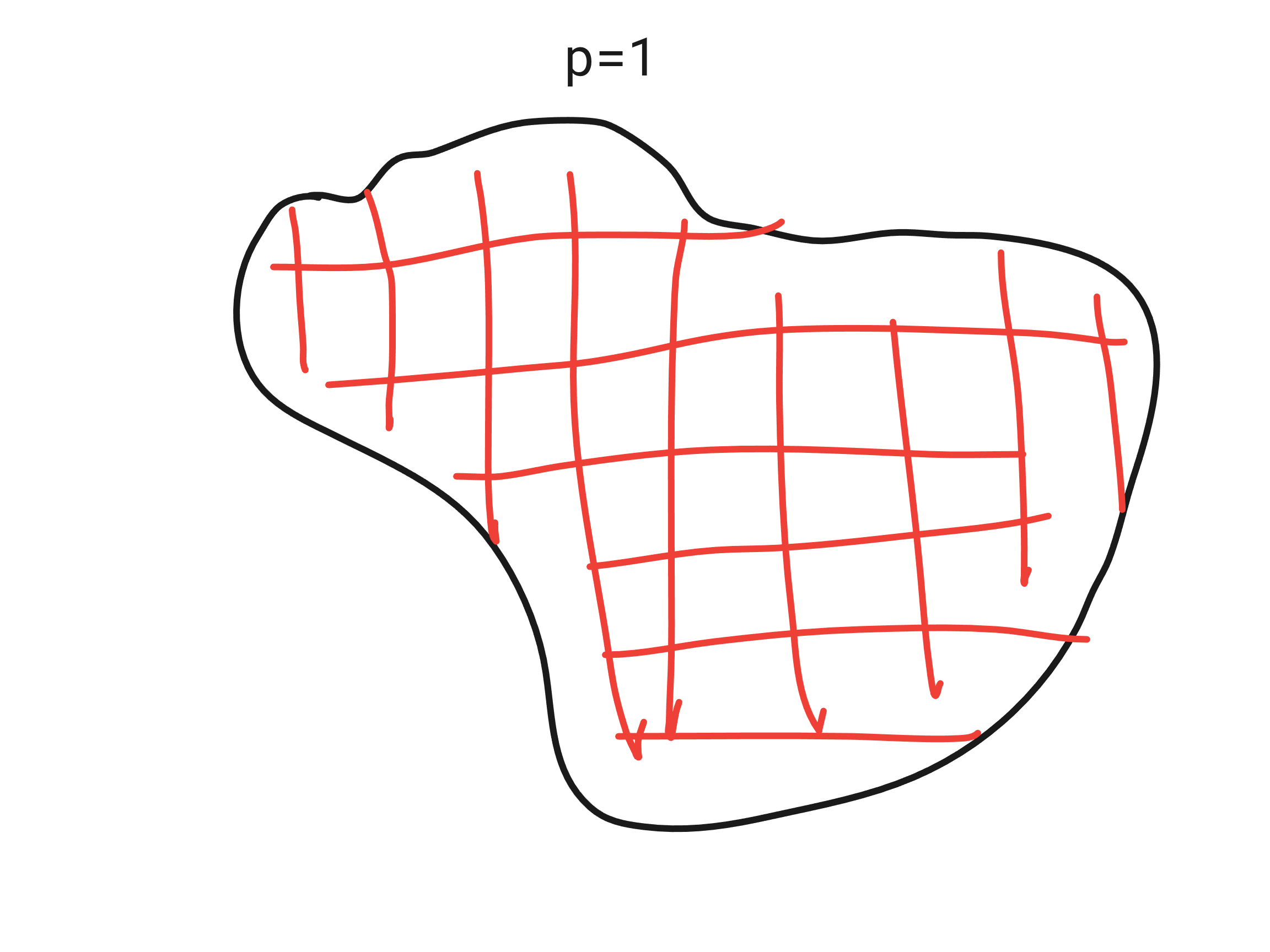 Imagine each prefix \sigma as carving out a subcube (cylinder set) of all points that agree with \sigma. Then taking the union fills up the region where U = p^{-1} (1). By compactness, there is always a finite subcover but our algorithm refines this so that they are also disjoint.
examples
-- fib-eventually (7 cylinders)

\x -> any (\f -> f < 30 && x f) (takeWhile (< 30) fibonacci)
This checks: “Does the infinite binary sequence x have True at any Fibonacci
position < 30?”
The 7 cylinders represent the minimal decision tree:
- If x[1] = True = predicate is True (fib 1)
- Else if x[2] = True = predicate is True (fib 2)
- Else if x[3] = True = predicate is True (fib 3)
… and so on for positions 5, 8, 13, 21
-- prime-eventually (8 cylinders)

\x -> any (\p -> p < 20 && x p) (takeWhile (< 20) primes)
This computes primes on-demand from primes = filter isPrime [2..] (infinite list), then checks if x is True at any prime position < 20. The 8 cylinders correspond to checking positions 2, 3, 5, 7, 11, 13, 17, 19 in
sequence.
-- collatz-reaches-1 (942 cylinders!)

\x -> let collatz n = if even n then n `div` 2 else 3*n+1
        orbit n = takeWhile (/= 1) (iterate collatz n)
    in length (orbit (sum [i | i <- [0..9], x i] + 1)) < 50
Again expanding this gives us:
1. Takes first 10 bits of x, sums the indices where x[i] = True, adds 1
2. Computes the Collatz orbit of that number (3n+1 conjecture)
3. Checks if the orbit reaches 1 in < 50 steps
Certain predicates over infinite sequences can be decided by examining only finite prefixes, and algorithms like sme can discover these finite characterizations. I wonder if there is something interesting in representing this as finite automata. In the next blog, we’ll go into some implications of introducing Randomness.
I came across this blog on Schrodinger’s equation when trying to come up with the intro, it seems pretty interesting.↩︎
Each finite prefix \sigma: F \rightarrow \mathbb{B} (where F is the local modulus of continuity[^3]) defines a cylinder set [\sigma] = \{x \in \mathbb{B}^\mathbb{N} | x|_F = \sigma\}. If a new finite prefix \tau extends \sigma, then [\tau] \subseteq [\sigma]. A small exercise is to prove that there si no way for two distinct prefixes two be returned. Consequently, \{ \sigma \} defiens an antichain under this extension order. Algorithmically, this is enforced by minimality and early stopping.↩︎